
China, Japan and Lithium: Exiger CEO’s Warning to the West
When Brandon Daniels, CEO of Exiger, warns that a single chokepoint could cripple Western supply chains, it is worth taking notice.
He is not about the Strait of Hormuz or the Middle East. He is not talking about oil, gas or even rare earths.
He is instead referring to lithium salts, a vital building block of modern batteries that he notes are only manufactured in Japan and China.
A conflict in that region, he says, would prevent the West “being able to do energy transition work” or “build drones at scale”. In fact, he argues, the West would suddenly be unable “to do any of the things we want to do.”
For boardrooms that still file supply chains under ‘operations’, this is an uncomfortable reframing. Further warning, as if it were needed, that we are entering a new age of geopolitical instability with global repercussions.

Daniels, who was speaking at the Semafor World Economy, was asserting that the West's energy transition, advanced defence capabilities and the broader digital economy now rest on narrow, often opaque upstream chemical processes, not just on headline commodities like spodumene or brine.
Events in the Middle East, and the continuing restrictions on freight through the Strait of Hormuz in Iran, are all the proof required.
Existential vulnerability
As we have seen, if these crucial processes are geographically concentrated inside a potential flashpoint, vulnerability becomes existential, not theoretical.
Scratch the surface and the lithium salts example looks less like hyperbole and more like a stress test for Western industrial policy.
Governments have poured billions into gigafactories, EV incentives and grid-scale storage, but much less into mapping and localising the precursor chemistries that make those investments usable.
Defence planners, meanwhile, talk about swarming drones and autonomous systems, while tolerating single-region dependencies for the very materials that power them.
Sustainability, procurement and supply chain leaders won’t want to miss Procurement & Supply Chain LIVE, taking place at Navy Pier, Chicago, on April 21–22.
Co-located with Sustainability LIVE: The US Summit, the event unites senior decision-makers at a time when supply chains, sustainability and business performance are more interdependent than ever.
Secure your place now for The US Summit – group booking discounts available.
Daniels’ company lives off exposing those bottlenecks for governments and primes, so there is commercial self‑interest in the way he frames the risk.
But the scenario he theorises does what all effective risk narratives should do: it forces C-suites to move the conversation from generic "China risk” to precise questions on which specific chemistries, components and process steps in the value chain are single-sourced in potential conflict zones.
That is a very different discussion to debating whether to dual-source a contract manufacturer.
An early warning
For supply-chain leaders, the lithium salts quote can be turned into a checklist.
Do leaders know their exposure to regionally-concentrated advanced materials beyond tier one, including where precursor chemicals are made, not just mined?
Are they feeding that visibility into capital allocation and R&D, so that ‘friendshoring’ and substitution efforts target the true single points of failure?
And, crucially, are they engaging policymakers early enough that industrial strategy and defence planning do not ignore the unglamorous, upstream parts of the supply chain?
If the answer to those questions is ‘no’, Daniels’ warning about lithium salts is less a thought experiment and more an ominous early warning.
Company portals

Executives
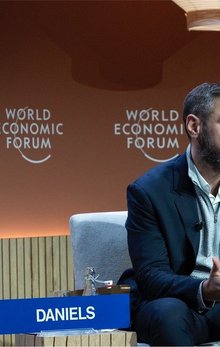
Brandon Daniels
Chief Executive Officer