Artemis II: The 2,700-Supplier Moon Mission
The spacecraft taking NASA astronauts beyond the moon for the first time since 1972 demonstrates one of the most complex supply chain operations ever assembled.
With more than 2,700 suppliers spanning the United States and Europe, the Artemis II mission illustrates how large-scale aerospace programmes rely on intricate networks of contractors to deliver components that must work flawlessly in the harshest environment imaginable.
NASA's Artemis II mission will take four astronauts the furthest into space that any humans have been. Manufacturing of the space rocket began in 2011, adapting Space Shuttle engines for a new era. While NASA is the architect, the actual manufacturing is handled by a network of thousands of private companies including Boeing, Lockheed Martin, Northrop Grumman and Airbus.

Building the crew capsule and service module
Lockheed Martin is the prime contractor for the crew module where the four astronauts will live. Orion is the only human-rated spacecraft designed to carry astronauts into deep space and bring them home. Many components from the Artemis I spacecraft are being reused, including nine avionics units and one seat.
More than 150 parts of the craft have been 3D printed, an increase from the four that were part of its first test flight in 2014. Augmented reality was used during assembly to help reduce engineer training time and cut some manufacturing tasks from eight hours to just 45 minutes.
Airbus manufactured the European Service Module (ESM) which provides the Orion spacecraft's power, propulsion and life support. The ESM has 33 engines and four solar wings, each seven metres long, that generate 11.2 kW of electricity. More than 20,000 parts are used in each ESM including around 12 kilometres of cables.
ESM-2, made for the Artemis II mission, was delivered to Florida in October 2021.
Marc Steckling, Head of Earth Observation, Science and Space Exploration at Airbus, says: "Together with the European Space Agency, Airbus is providing half the spacecraft that will return humans to the moon."
Propulsion systems power the journey
Four RS-25 engines, refurbished from Space Shuttles, are set to be used alongside solid rocket boosters for Artemis II. These were designed in the 1970s by Aerojet Rocketdyne, now part of L3Harris Technologies, and have been upgraded for NASA's Space Launch System (SLS) rocket. Engine 2047 previously flew on 15 Space Shuttle missions including the final flight in 2011.
The 65-metre tall core stage was manufactured at NASA's Michoud Assembly Facility in New Orleans by Boeing. This supplies propellants to support engine thrust, booster force and the weight of the Orion. The mission's core stage was delivered to the Kennedy Space Center on 24 July 2024.
Northrop Grumman built the twin solid rocket boosters, which provide more than 75% of the initial thrust. The company also manufactures the attitude control motor and abort motor for the Launch Abort System.
United Launch Alliance built the interim cryogenic propulsion stage (ICPS) which provides the final push towards the moon. This stage was manufactured at the rocket factory in Decatur, Alabama and delivered to the Kennedy Space Center in March 2025.
Final assembly and launch preparation
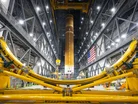
The Orion spacecraft and SLS were stacked together inside NASA's Vehicle Assembly Building at the Kennedy Space Center. This process began in late 2024 and continued for roughly a year.
The five-segment solid rocket boosters were assembled first and the core stage was then lifted and placed between the boosters. Next, the ICPS and Orion capsule were added to the launch vehicle.
Each component must be precisely aligned and integrated to ensure the structural integrity of the entire launch system. Engineers conduct extensive testing at each stage of assembly to verify that all connections and systems function correctly before proceeding to the next phase.
The rocket was then moved from the building to the launch pad over 12 hours at a maximum speed of just 1.3 km/h in January 2026. After testing and rehearsals, the rocket is ready to take the Artemis II crew around the moon.
Company portals







Executives
Jim Kalberer
Vice President Business Unit
Marc Steckling
Head of Earth Observation, Science and Space Exploration