Can 3D Printing Help BMW Increase Supply Chain Efficiency?
Additive manufacturing has been part of BMW Group's production toolkit since 1991. Throughout this time, its role has changed from producing prototype parts for concept cars to becoming a core maintenance and engineering strategy across the automaker's global factories.
At BMW's dedicated Additive Manufacturing Campus in Oberschleißheim, near Munich, more than 300,000 parts were printed in 2023 alone. Across the wider global production network, spanning plants in Spartanburg in the United States, multiple German sites and facilities in Asia, a further 100,000 printed parts are produced every year.
The technology now supports everything from bespoke orthoses to large-scale robot grippers used on press lines.
See the full story in the April 2026 edition of Manufacturing Digital.
Lighter tooling
Jens Ertel, retired Head of BMW Additive Manufacturing, explains: "We are able to quickly, economically and flexibly produce our own production aids and handling robots, which we can individually adapt to specific requirements at any time, as well as being able to optimise their weight. Less weight allows higher speeds on the production line, shorter cycle times and reduced costs."
The link between weight reduction and maintenance is direct. Lighter tooling places less stress on the mechanical systems, like motors, bearings and joints, that carry it. Reduced mechanical stress translates into longer component life and fewer unplanned stoppages.
At BMW Group Plant Landshut in Bavaria, additive manufacturing has been embedded in day-to-day production for many years. One long-standing application involves sand-based 3D printing, a process in which thin layers of sand are bonded together with chemical binders to create moulds. These moulds are then filled with liquefied aluminium to produce components such as cylinder heads.
Klaus Sammer, Head of Product and Process Planning for Light Metal Casting, explains: "This technology is typically used to manufacture prototype casts, as well as for the large-scale production of components for high-performance motors."
Roof grippers at Landshut
Weight makes a big difference in the production of carbon fibre reinforced polymer roofs at Landshut. Handling raw CFRP sheets and finished roof panels requires purpose-built robot grippers with end-of-arm tooling that clamps, lifts and repositions components on press lines.
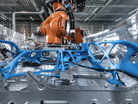
The Lightweight Construction and Technology Centre at Landshut uses a large 3D-printed gripper element for this process. The gripper weighs around 120 kilograms and can be manufactured in just 22 hours. It is a hybrid of two printing methods: vacuum cups and needle-gripper clamps are produced using selective laser sintering, while the main shell and load-bearing frame use large-scale printing from recycled plastics.
The gripper performs two functions in a single pass, loading raw CFRP and extracting the finished roof panel. This reduces cycle time and cuts robot movements per part.
From three robots to one
In summer 2023, BMW Group introduced a more refined gripper design at Landshut, beginning with a topological analysis of the previous design. The result was a bionic gripper modelled on the load-bearing logic of natural forms such as bone or branching systems.

The new gripper is 25% lighter than its predecessor. This allows for the entire CFRP roof manufacturing process for the BMW M3 to be carried out by a single robot, where previously three were needed. Less robots in the cell means fewer systems to maintain, fewer potential failure points and lower energy consumption.
Software automation
Designing bionic structures requires specialist computational tools. BMW uses software called Synera to perform topological optimisation calculations, removing material from areas of low stress and retaining it where loads are highest.
These designs can be sent directly to a 3D printer without further modification. At the Additive Manufacturing Campus, standardised workflows now automate lots of the calculation and design process, reducing the time between identifying a maintenance need and producing a finished replacement part.
Extending service life
In BMW Group Plant Munich, bionic floor-assembly grippers handle the complete underfloor structure of the BMW i4 electric saloon. The bearer is produced using sand casting with a 3D-printed mould, resulting in an aluminium structure weighing 110 kilograms, around 30% less than the previous conventional model.
Markus Lehmann, Head of Plant Engineering and Robotics at BMW Group Plant Munich, explains: "When handling the full BMW i4 floor assembly, this allowed us to reduce the weight of the complete gripper by 30% — 50 kg — and thus to extend the service life of our facilities."
The ability to produce lighter, purpose-optimised tooling on demand and to replace it rapidly when needed, is changing how the group manages equipment longevity, unplanned downtime and the total cost of keeping a modern production line running.
See the full story in the April 2026 edition of Manufacturing Digital.
Company portals

Executives
Klaus Sammer
Leiter Prozess- & Produktplanung, Plant Landshut