
Top 10: Electric Vehicle Fleets
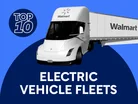
Electric vehicle fleets are transforming companies' approach to logistics.
With trucks responsible for nearly 40% of global transport emissions, electrification is fast becoming a necessity.
EVs cut tailpipe emissions to zero, slash air pollution in congested cities and offer lower running costs thanks to fewer moving parts and cheaper charging.
As emissions zones tighten and deadlines loom for combustion engine phase-outs, going electric now means future-proofing operations.
Thanks to government incentives, happier drivers and credits for clean transport, EV fleets are morphing beyond sustainability tick-box exercises into truly valuable business moves.
10. IKEA/Ingka Group
Employees: 231,000
CEO: Jesper Brodin
Founded: 1943

IKEA is becoming increasingly known not for its Billy Bookcases but for its sustainable business model. In line with this, it has assembled one of the world’s most committed EV delivery fleets.
Through Ingka Group, it’s targeting 100% zero-emission deliveries by 2025 and is scaling fast.
From electric tuk-tuks in India to full-size delivery trucks in Greater London, IKEA’s fleet grows each year, with city after city hitting 100% electric milestones. Glasgow, Shanghai and Amsterdam are already there, while partners like Wincanton and Renault are tailoring solutions for IKEA’s needs.
9. DHL
Employees: 595,000
CEO: John Pearson
Founded: 1969
DHL is building a logistics ecosystem that thinks electric from the ground up.
With more than 29,200 EVs in action worldwide and a bold plan for 60% of deliveries to go electric by 2030, it’s clear DHL is not waiting for the future. Its global EV Centres of Excellence manage battery storage, hazardous goods and even run tests on EV components.
From Asia to the US, DHL is weaving electrification into every level of its network, using smart charging, load balancing and real-world logistics know-how to lead the sector.
8. Schneider Electric
Employees: 150,000
CEO: Olivier Blum
Founded: 1836
Schneider Electric is committing to make its 1,200-vehicle company car fleet fully electric by 2025.
The multinational giant is not just setting targets—it’s actively reducing its own carbon output, aiming for an 80% cut in direct CO2 emissions by 2025 and net zero by 2030. Through at-home chargers and a greener car scheme, employees are brought into the transition.
All this forms part of EV100, the global initiative for corporate fleet electrification. Schneider’s approach proves that, when the technology is yours, the best way to lead is to use it yourself.
7. UPS
Employees: 490,000
CEO: Carol Tomé
Founded: 1907

UPS’ London depot runs on a smart charging system that dodges grid overloads with on-site batteries and clever load management.
These aren’t off-the-shelf vans, either, as UPS partners with Arrival and Iveco to customise electric vehicles for city life.
With 18,300 low-emission vehicles already active and a promise of 40% alternative fuel use by 2025, UPS is building an electric logistics backbone fit for global scale.
6. BMW
Employees: 159,000
CEO: Oliver Zipse
Founded: 1917
BMW is electrifying the road between production and delivery with precision and purpose. Its EV fleet stands out because it targets the nuts and bolts of logistics, daily factory runs and vehicle distribution, where emissions often go unnoticed.
In Leipzig and Regensburg, electric trucks shuttle parts for high-voltage batteries up to 12 times a day, saving nine tonnes of CO₂ a year and cutting noise near the plants.
Meanwhile, in France, BMW’s electric car carriers clock up to 270km a day delivering vehicles around Paris.
5. Siemens
Employees: 327,000
CEO: Roland Busch
Founded: 1847
Backed by Depot360, Siemens has a system that ensures its own depots are fitted with smart, AI-powered charging solutions that keep vehicles ready without overloading the grid. With a digital-first approach and direct manufacturer collaboration, Siemens is building a zero-emission fleet from the inside out.
Siemens teams up with leasing companies, suppliers and telematics experts to shrink lead times and stretch performance.
Whether it’s municipal buses or corporate vans, Siemens combines green energy, AI and digital tools to electrify fleets with zero fuss and full control.
4. PepsiCo
Employees: 319,000
CEO: Ramon Laguarta
Founded: 1965

PepsiCo’s goal is to reach net zero by 2040 and the company is scaling EV adoption at serious speed. It was first to put Tesla’s all-electric Semi trucks into real-world use in 2022 and has now deployed more than 700 EVs across the US.
Its California expansion adds 50 Tesla Semis and 75 Ford E-Transit vans, supported by Tesla’s high-powered chargers and energy storage systems.
From urban snack runs to long-haul beverage hauls, PepsiCo proves that big logistics can go clean without slowing down. It’s EV adoption at corporate scale.
3. Comcast
Employees: 139,000
CEO: Brian Roberts
Founded: 1963
Comcast is plugging into the EV transition from both sides—fleet and infrastructure. What makes Comcast stand out is its Smart Solutions division, which is powering up EV charging across cities, businesses and homes.
With partners like NovaCHARGE, it's delivering open-platform, revenue-friendly, low-maintenance charging networks.
Comcast may not be flaunting numbers, but it’s laying the foundation, one charge point at a time, for others to electrify with confidence.
2. Amazon
Employees: 1.5 million
CEO: Andy Jassy
Founded: 1994
Amazon defines last-mile delivery. With more than 20,000 Rivian electric vans already on the road in the US and in excess of 300 in Germany, the strategic partnership has moved from promise to powerhouse and has helped the company deliver more than a billion packages using EVs.
Amazon is rolling with at least 15 electric vehicle types worldwide, from e-rickshaws in India to massive electric trucks in the UK and Europe.
What’s more, its €1bn (US$1.1bn) investment in eHGVs, not to mention 24,000 chargers installed across 150 US delivery stations, means Amazon is increasingly taking responsibility for the EV infrastructure itself.
1. Walmart
Employees: 2.1 million
CEO: Doug McMillon
Founded: 1962

A pioneer in the realm of corporate sustainability, Walmart is already electrifying at scale. As one of the first companies to trial the Tesla Semi, it’s now rolling them out in both the US and Canada, with 130 trucks ordered through Walmart Canada alone.
Walmart’s also backing Canoo and BrightDrop with thousands of electric delivery vans heading to support ecommerce fulfilment.
While other companies discuss long-term plans, Walmart is building here and now by installing EV charging stations at thousands of stores by 2030. With hydrogen pilots and battery storage in the mix, Walmart is truly future-proofing retail logistics.
To read the full article in the magazine, click HERE.
Explore the latest edition of Supply Chain Digital Magazine and be part of the conversation at our global conference series, Procurement & Supply Chain LIVE.
Discover all our upcoming events and secure your tickets today.
Supply Chain Digital is a BizClik brand.