
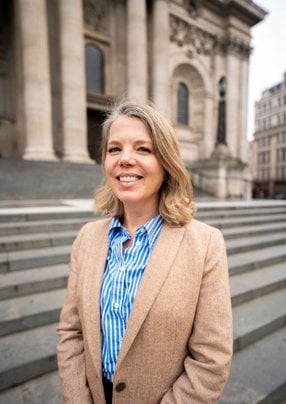
Saskia van Gendt
Chief Sustainability Officer
We often talk about innovation in the supply chain sector - but what does that actually mean without ensuring there’s a future to innovate for and towards?
Sustainable development must now be at the core of every business, with Scope 3 often accounting for more than 70% of a company’s total GHG emissions.
This is a mission at the heart of Blue Yonder, where the software company’s first Chief Sustainability Officer Saskia van Gendt leads sustainable supply chain innovation.
With nearly two decades in the field, Saskia brings environmental science expertise and a clear vision for how supply chains must evolve to be more resilient, more transparent and less carbon-heavy.
Saskia is no stranger to the frontline of sustainable innovation. Before joining Blue Yonder, she shaped bold environmental programmes at both Rothy’s - where she championed circular production - and Method, applying plant-based innovation across operations. Now, she applies that same practical, results-driven mindset to global supply chains.
Full Name: Saskia van Gendt
Job Title: Chief Sustainability Officer
Company: Blue Yonder
Saskia brings serious impact to her role as Blue Yonder’s first Chief Sustainability Officer. As an environmental scientist with 18 years of hands-on experience and a track record for turning green goals into real-world action, she’s steering sustainability from the lab to the loading dock.
Her role at Blue Yonder stands out because of how directly it connects sustainability with digital transformation. The company’s AI-powered platform enables businesses to plan and react faster, using data to anticipate disruptions, balance inventory and reduce waste.
“Blue Yonder is the world leader in digital supply chain transformation,” she explains. “Retailers, manufacturers and logistics service providers worldwide rely on us to optimise and accelerate their supply chain from planning and fulfilment to delivery and returns.
McKinsey found that AI-driven tools can enable a 35% decrease in inventory levels, reducing both costs and waste, whilst in food supply chains about 13% of food is wasted upstream (between harvest and retail) - AI-driven planning systems help drastically reduce this waste, supporting global sustainability goals such as the UN’s target to halve food waste by 2030.
At Blue Yonder, Saskia’s challenge - and opportunity - lies in making sure those capabilities deliver tangible climate benefits. For her, helping companies meet demand must be done without compromising the future.
Blue Yonder puts purpose into practice by aligning its supply chain solutions with four of the United Nations Sustainable Development Goals. From reducing waste and improving food traceability to optimising healthcare supply chains and cutting carbon emissions, the company helps businesses act more sustainably. With a commitment to net zero Scope 1 and 2 emissions by 2030 and a full switch to renewable energy, Blue Yonder is also investing in products that support ethical sourcing and measurable climate action.
AI and sustainability working in harmony
Blue Yonder has been “using different forms of AI in its solution for many years,” according to Saskia. It is strategically leveraging its expanding Software as a Service (SaaS) to fuel its AI investment, in turn promoting sustainability in supply chain management.
“At its core, AI enables end-to-end improvements across the supply chain,” she says. “When we think about the future of AI, especially as it overlaps with sustainability, the way that I'm thinking about it is that a lot of the optimisation that we can get from the use of AI will only accelerate the benefits from a sustainability perspective.
“For example, we’re able to use more intelligence in the planning process because we have a lot of customers who are doing their inventory and manufacturing planning. They need to feed in all of the data sets around different trends, weather, local preferences and holidays - and all of these variables that can be very neatly distilled using AI,” she explains.
“I really just see it as an accelerator for the measurable impact that we can deliver to customers.”
Supply chain efficiency meets climate goals
As AI becomes increasingly integral to supply chain optimisation, companies are leveraging advanced platforms like Blue Yonder to enhance efficiency and agility. However, the growing reliance on AI also raises important questions about the environmental impact of the data centres that power these systems, forcing us to consider how companies like Blue Yonder address the sustainability challenges associated with the energy demands and carbon footprint of its AI infrastructure.
“I’m really pleased there’s a focus on the appropriate use of AI to match the need for its application,” Saskia says. “Not everything needs to be generative AI, which is very energy intensive. There’s also a lot of energy that goes into the training of these models which eventually moves into the use of them.
“So, when I look at greener software design, I consider using smaller language models to match a very specific need - that’s the first line of action. The second is choosing your data centre partners or cloud providers to make sure they’re on that decarbonisation journey with you.”
The company approaches supplier relationships with clear expectations, using a structured set of environmental criteria to assess each potential partner. These questions focus on how well suppliers align with Blue Yonder’s broader sustainability goals.
As part of this process, Blue Yonder also relies on ECO, a third-party assessment tool that evaluates suppliers through an environmental lens. This helps ensure transparency and accountability across the supply chain. The goal is not only to meet current standards but to raise the bar over time. By putting sustainability front and centre, Blue Yonder ensures its partnerships contribute to a more responsible and climate-conscious supply chain.
“Then there are all these ways that you can reroute energy,” says Saskia. “For example you can source from off-peak in France and on-peak in the US, balancing where the energy loads are coming from. Ironically, though, a lot of the knowledge we get about where those sources are from is actually powered by AI.”
Proactive resilience through AI-enabled transparency
Effective transparency reporting is now essential for companies aiming to build sustainable supply chains. AI-driven analytics provide full visibility by tracking materials, measuring environmental impact and ensuring compliance across every level of production. These tools help bridge the gap between reporting goals and actual performance.
Saskia explains: “The European regulations, Corporate Sustainability Reporting Directive (CSRD) and Corporate Sustainability Due Diligence Directive (CSDDD) represent a shift in sustainability reporting - one that looks set to catalyse transformational changes around how companies align on disclosure standards and improve transparency around meeting environmental and social objectives.
“Both CSDDD and CSRD elevate the crucial importance of transparency and accountability in global supply chains,” she continues. “AI-enabled solutions allow businesses to gain visibility across every tier of the supply chain down to the raw material level and all production processes.”
Amid shifting trade policies, AI also helps firms respond to uncertainty.
"Even day by day, week by week, there’s a different signal to the industries around what might come with a tariff in what region," Saskia adds.
“I think it was unanticipated that there would be tariffs on Mexico because previously it had been spoken that there would be tariffs in China. So now companies are again facing a bit of that whiplash. They've made decisions to try to bring things more locally, maybe poke more on North America as a region and now that's seen as less resilient.”
By modelling different scenarios, companies can assess cost impacts, adjust sourcing and respond in real time through the Blue Yonder network.
“Technology like what we offer at Blue Yonder is a good tool to be able to measure around all of that uncertainty, run different scenario plans and assess sourcing locations that are taking in different costs associated with that,” notes Saskia.
Some industries face bigger hurdles. “There are these embedded ecosystems of manufacturers, raw materials, intermediate material sourcing that exist in certain regions, especially within China,” she explains. Relocating entire systems is difficult, especially when past efforts, such as shifting to Mexico, have been undermined by unexpected tariffs.
The future of supply chain emissions reduction
Looking to the future, AI is set to become indispensable for building sustainable, efficient and transparent supply chains - but how does it tackle the industry’s biggest challenge - Scope 3 emissions?
For Blue Yonder, the biggest Scope 3 impact will be felt in its wider customer base. The focus is on scaling optimisation. By helping customers reduce emissions through better planning and logistics, Blue Yonder contributes to decarbonisation even if the results do not appear directly in its own emissions accounting. “That’s really where we’ll see the most sustainability value,” Saskia says.
There’s also a key principle to maintain: “How do we measure the net benefit that we're getting from AI in terms of decarbonising, and ensure that improving energy efficiency is greater than the increased energy use,” she states. That balance must be tracked over time, even if the efficiency gains are achieved through customers. “It’s not necessarily on our balance sheet but we want to make sure that overall energy use is being considered and that we're decarbonising in the big picture.”
Saskia concludes aptly: “That is the thesis... we are using AI to achieve more efficiency in the long run, but we need to be able to measure how that balance of emissions and energy use is shifting over time.”
With her at the helm, Blue Yonder is guiding the industry on a path to sustainable innovation that should create a more efficient, resilient and greener future for all.
To read the full article in the magazine, click HERE.
Explore the latest edition of Supply Chain Digital Magazine and be part of the conversation at our global conference series, Procurement & Supply Chain LIVE.
Discover all our upcoming events and secure your tickets today.
Supply Chain Digital is a BizClik brand