
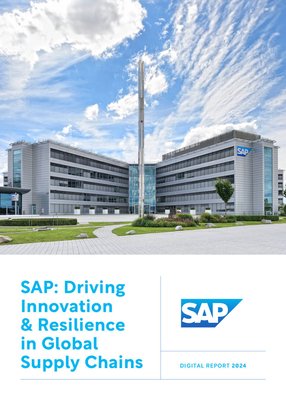
SAP: Driving Innovation & Resilience in Global Supply Chains
SAP is a global leader in enterprise software, providing solutions that help businesses manage their operations and customer relations effectively. Headquartered in Walldorf, Germany, SAP initially focused on developing software for financial accounting but has since expanded its offerings to encompass a wide range of business functions, including supply chain management, human resources and customer relationship management.
The company is best known for its ERP (Enterprise Resource Planning) software, which integrates various business processes into a unified system. This integration allows organisations to streamline operations, enhance productivity and make data-driven decisions. Over the years, SAP has evolved its solutions to meet the changing needs of businesses, particularly in the digital age.
A significant development in SAP's journey has been the introduction of the SAP Business Network, which complements its digital supply chain and procurement solutions. This product facilitates collaboration among trading partners and suppliers, enabling businesses to quickly respond to market changes and disruptions. The shift from rigid linear supply chains to dynamic supply networks has been a game changer, allowing for greater visibility and flexibility in supply chain management.
SAP's commitment to innovation is evident in its embrace of emerging technologies such as artificial intelligence and machine learning, which enhance data analysis and decision-making processes. The company's focus on sustainability and responsible business practices further underscores its role as a leader in the enterprise software market. With a diverse global customer base across various industries, SAP continues to drive digital transformation, helping organisations navigate the complexities of modern business environments. Since its founding over 50 years ago, SAP remains dedicated to empowering companies to achieve their goals through integrated technology solutions.
In an era of rapid technological advancement and changing market dynamics, SAP stands at the forefront of supply chain innovation. The company is helping thousands of leading organisations across the globe create more efficient, responsive and resilient supply chains that can swiftly adapt to changing market conditions and customer demands. By leveraging cutting-edge technologies and fostering unprecedented levels of collaboration, SAP is redefining the future of procurement and supply chain management.
SAP Business Network: Revolutionising Supply Chain Collaboration
At the heart of SAP’s transformative approach to supply chain management lies the SAP Business Network. Launched in 2021, this groundbreaking cloud solution connects millions of businesses across the entire supply chain spectrum – from buyers and suppliers to manufacturers, logistics providers and services providers. The network serves as a digital ecosystem, where organisations can seamlessly connect and collaborate, sharing critical data and workflows with trading partners across their supply chains.
Tony Harris, Senior Vice President for SAP Business Network Product Marketing , emphasises the network’s pivotal role: “SAP Business Network helps strengthen trading partner relationships across procurement, supply chain, logistics and asset management. This integration improves efficiency, mitigates risk and disruption and drives sustainability across the entire value chain.”
The impact of the SAP Business Network is nothing short of remarkable. In the last 12 months, more than £4.6 trillion of commerce was processed through the platform, underscoring its significant influence on global trade. This staggering figure not only demonstrates the network’s widespread adoption but also highlights its critical role in facilitating modern business operations.
Tony elaborates on the network’s capabilities: “SAP helps customers address contemporary supply chain challenges through our comprehensive suite of software solutions. This includes integrated business planning and transportation management, which work in tandem with our business network. Moreover, our solutions are supplemented by the knowledge and expertise of our global partner ecosystem, which has developed specialised services around SAP's technology.”
This extensive network of partners, which already includes 26,000 partners across the world, plays a vital role in SAP's ability to provide comprehensive solutions across a wide range of businesses and locations. This partnership approach enables SAP to extend its reach and enhance what it offers with specialised solutions created by partners, ensuring that users see their toolboxes expand and have access to the tools they need. “SAP cannot build everything itself,” Tony admits, “but our core technology stack allows partners to build solutions independently. This ecosystem approach ensures that we can meet the diverse and growing needs of businesses across all industries and geographies.”
Elevating Supply Chain Management to Strategic Importance
The evolving business landscape has catapulted supply chain management from a back-office function to a core strategic priority. As organisations grapple with increasingly complex global markets, the ability to manage supply chains effectively has become a key differentiator.
“We're witnessing a paradigm shift in how businesses view supply chain management,” Tony notes. “Planning and visibility are now being discussed at the board level in just about every company. This elevation has positioned supply chain management as absolutely strategic and critical to the success of the company.”
This shift in perspective is driving businesses to seek more sophisticated, integrated solutions that can provide end-to-end visibility and control over their supply chains. SAP’s suite of solutions is designed to meet this growing need, offering tools that enable businesses to not just manage but optimise their supply chains.
For Tony, the definition of a best-run supply chain is clear: “It’s all about delivering on the customer promise. This means getting the right product to them at the right time, in the right location, at the right quality and price. SAP helps companies achieve this through our suite of integrated software solutions that address all aspects of the supply chain, from demand planning and procurement to logistics and fulfilment.”
SAP: Empowering Businesses of All Sizes
One of the most prevalent misconceptions about SAP is that its solutions are exclusively for large enterprises. However, this couldn’t be further from the truth. In fact, approximately 80% of SAP’s customers are small and medium-sized enterprises (SMEs), not large corporations.
Tony explains this surprising statistic: “It’s a common misunderstanding that SAP is only for big companies. In reality, we serve businesses of all sizes. SMEs are doing the same things as big companies, just not in the same volumes yet. Many small companies go on to become the next big companies and they need solutions that can scale with their growth.”
This versatility is one of SAP’s key strengths. The company’s solutions are designed to be scalable and adaptable, capable of meeting the needs of a small start-up as effectively as those of a multinational corporation. “Small companies need powerful functionality and they need it to work out of the box and quickly,” Tony adds.
“Our solutions are now being deployed and adopted by companies of all sizes, providing them with enterprise-grade capabilities that can grow with their business.”
Interestingly, SAP’s cloud ERP solutions are gaining significant traction among large enterprises as well. These organisations are recognising the need to simplify their processes to be more agile and efficient, mirroring the lean and nimble approach of many successful SMEs.
“The beauty of SAP is that you can still have it your way,” Tony emphasises.
“We provide a core solution with best-in-class processes and capabilities delivered out of the box, but you can still make customisations when needed. This flexibility allows businesses of all sizes to tailor our solutions to their specific needs while benefiting from our proven best practices."”
Addressing ESG and Sustainability Challenges
In recent years, Environmental, Social and Governance (ESG) considerations have moved from the periphery to the centre of business strategy. With increasing regulations and customer awareness, businesses are under pressure to not only monitor but actively improve their ESG performance. SAP has responded to this shift by developing a range of solutions designed to help businesses meet these new challenges.
“There has been a lot of regulation introduced around the world across a number of these topics,” Tony notes.
“You're not going to see that scale back anywhere – companies have to get used to adapting to these new regulations. We have introduced and will continue to introduce, a range of solutions to help companies address and be compliant with these various regulations.”
Two key solutions in SAP’s sustainability portfolio are the SAP Sustainability Data Exchange and SAP Sustainability Footprint Management solutions. They are designed to help companies collect, analyse and report on sustainability data effectively. The Sustainability Data Exchange helps companies capture carbon emissions data throughout their supply chain, using industry-standard formulas to ensure accuracy and comparability.
This data then feeds into the Sustainability Footprint Management solution, giving companies a comprehensive view of their environmental impact. “These solutions are becoming increasingly integral as customers embrace them to help meet their net-zero targets,” Tony explains.
SAP’s commitment to sustainability extends beyond its product offerings. The company has an entire sustainability line of business dedicated to understanding this space, working hand-in-hand with its internal sustainability organisation to ensure SAP remains one of the most sustainable companies in the technology sector.
The Future of SAP: Business AI and S/4HANA
As we look to the future, SAP is positioning itself as a leader in business AI, with a steadfast goal of integrating AI across all business processes. Tony envisions AI becoming a game-changer for supply chain management, particularly in processing vast amounts of data quickly and accurately.
“Business AI is going to be one of the game changers – not the only game changer, but certainly one of them – in being able to process data in the context of the current situation and make suggestions as to the best course of action or courses of action that us humans can then implement,” Tony adds.
This focus on AI is part of SAP’s broader strategy to continue innovating and providing cutting-edge solutions to its customers. Another significant aspect of this strategy is the transition from SAP’s Enterprise Central Component (ECC) ERP, to the next generation, SAP S/4HANA.
SAP S/4HANA represents a significant leap forward in ERP technology, offering enhanced capabilities and flexibility, particularly in cloud deployment. “We can’t continue to innovate on a legacy platform when the market is driving us more towards that cloud base,” Tony notes.
“Companies have got a target to consider to really get off the old stack and get onto the new stack and be able to take advantage of some of these great new capabilities and technologies like business AI and the analytics capabilities that we offer.”
The migration from ECC to S/4HANA has been successful, with many customers already benefiting from the new platform’s capabilities. This transition is not just about updating technology; it’s about providing businesses with a foundation for future growth and innovation.
SAP Business Network: A Vision for the Future
Looking ahead, SAP’s vision is clear: to make SAP Business Network the leading solution and the hub around which trading partners collaborate.
“We want SAP Business Network to be ubiquitous, to become the way to manage trading partner collaboration across all business processes,” Tony states.
“We want there to be equal value in equal measure between those trading partners so that every type of business ultimately benefits from joining what is the world’s largest B2B platform. That is our goal in a nutshell.”
SAP’s Role in Shaping the Future of Supply Chains
As supply chains continue to evolve and face new challenges, SAP’s role in driving innovation and resilience becomes increasingly crucial. By providing cutting-edge solutions that facilitate collaboration, enhance visibility and enable data-driven decision-making, SAP is helping businesses of all sizes build supply chains that are not just efficient and resilient, but also sustainable and future-ready.
From the SAP Business Network to its sustainability solutions, from its commitment to AI integration to the transformative power of SAP S/4HANA, SAP is at the forefront of supply chain technology. As Tony concludes: “We want to see growth in the adoption of our business AI capabilities, growth in the adoption of our cloud ERP solution. And in my area, we’ll continue to help companies gain greater visibility, efficiency and compliance in their supply chains.”
In an era of rapid change and increasing complexity, SAP’s vision and solutions offer a path forward for businesses looking to turn supply chain challenges into opportunities for growth and innovation. As the company continues to evolve and adapt its offerings, it remains committed to its core mission: helping businesses bring out their best by building supply chains that are truly fit for the future.
**************
Make sure you check out the latest edition of Supply Chain Digital Magazine and also sign up to our global conference series - Procurement & Supply Chain LIVE 2024
**************
Supply Chain Digital is a BizClik brand
Company portals
Executives

Tony Harris
SVP & Head of Marketing & Solutions