
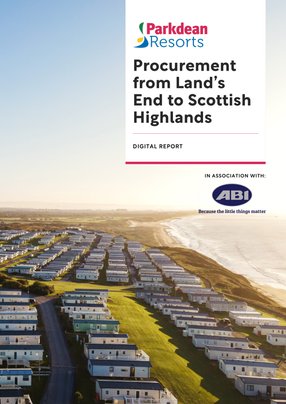
Parkdean: Procurement from Land’s End to Scottish Highlands
Parkdean Resorts, the UK's largest holiday park operator, presents unique procurement challenges. It runs 65 parks, which operate more like small towns spanning the entirety of the UK, from the north of Scotland to near Land's End in Cornwall.
Head of Procurement, Amey Fairbrother, heads up the company’s sophisticated supply chain management whilst ensuring the team caters to diverse geographical and seasonal demands.
Under Amey's leadership, the procurement function has undergone significant transformation, moving from complexity to simplification whilst simultaneously navigating an ambitious digital transformation programme.
With Amey at the helm, Parkdean Resorts has addressed the unique challenges of seasonal operations, remote locations and evolving customer expectations whilst building a resilient and innovative procurement function that contributes billions annually to the UK economy through the staycation sector.
Rolling out infrastructure across 65 'small towns'
Parkdean's digital transformation came with all the challenges of a traditional shift in operations, but with the added difficulty of implementing technology across a geographically dispersed operation.
Amey explains: "We're not just 65 parks, we're 65 parks with multifaceted commercial outlets and 30,000 individual accommodations spread across a range of topography across the country. So, a seemingly straightforward digital transformation like rolling out WiFi actually becomes incredibly complicated – it is like rolling out infrastructure for 65 small towns."
The procurement team's role in this transformation extends far beyond traditional purchasing activities. It is not just a case of building specifications to ensure appropriate technology, one size doesn't always fit all here – with parks situated from woodland areas to the beach.
Parkdean is also operating slightly differently from traditional procurement functions. While procurement often operates in a business-to-business environment, the organisation works in the business-to-consumer space too.
Parkdean's digital transformation had to keep the three million holidaymakers it welcomes annually in mind. That means a wide range of customer preferences, which span a broad spectrum due to the fact that the company maintains multiple service channels to accommodate varying comfort levels with technology.
"We have holidaymakers and holiday home owners that just want to talk to somebody on the end of the phone and we need to make sure we can still offer that service for our guests. Others may just want to talk to a chatbot because they want quick answers, while somebody else may want to book online and not talk to a person at all," Amey explains.
This customer-centric approach has significant procurement implications, requiring the maintenance of multiple technology platforms and service delivery methods simultaneously. The procurement team must resist the temptation to drive efficiencies purely through technology adoption and continue to meet the needs of their customer base.
“We don't want to alienate anybody who can come on holiday with us,” says Amey. “From a procurement perspective, we understand efficiencies might be driven through technology, but that's on a spreadsheet, not necessarily in reality. We've got to understand the real-world situation that we find ourselves in and ensure that when we're leading procurement tenders or scoping out different technologies, we continue to put the customer at the forefront of those decisions.”
From complexity to clarity
When Amey joined Parkdean Resorts, she encountered procurement processes that were more complicated than necessary. Her approach focused on fundamental simplification: "It's very easy to overcomplicate simple tasks. So we've gone back to performing the basics well, whether that's having clean data sets or having consistency in our approach where possible."
This back-to-basics philosophy extends beyond internal processes to stakeholder engagement. The procurement team recognises their impact on how stakeholders interact with suppliers, working to simplify these relationships across the organisation. The transformation has delivered tangible results, with Amey reporting that "over the last couple of years, we've seen significant improvements in the effectiveness of our procurement team. We've delivered innovations and we've delivered savings, which are still crucial for procurement."
Central to Parkdean's procurement success is intensive stakeholder engagement. The team works closely with internal partners to understand transformation needs across marketing, call centres and individual parks. This collaborative approach includes leveraging partner expertise, particularly in IT specification development and understanding evolving guest requirements.
The unique challenge of seasonal operations
Few businesses face the extreme seasonality that characterises holiday park operations. Amey describes this as "one of the biggest learning curves anyone joining the team has”. Few other businesses close their doors for months on end to then reopen and start again.
This seasonality creates massive peak trading requirements in locations that can be challenging to service. The procurement team manages these challenges through various strategies, including business continuity plans and dual sourcing arrangements. However, the key to success lies in maintaining "open and transparent conversations with our suppliers and regular relationship management with them,” says Amey.
“We want to ensure that our supply chain can provide their products and services so our guests can have an absolutely fantastic holiday. And we as a team have to understand what impact our seasonality can have on our supply chain and how we alleviate those pressure points.”
Rather than centralising procurement in a single location, Parkdean has embraced a distributed model with team members spanning Newcastle (where the company’s central office is based), London and Glasgow. This approach delivers multiple benefits, as Amey explains: "Having that kind of diverse procurement function, allows us to attract the best talent for the role because we're getting the best people no matter where they're located. It also means we can support the business face to face."
This has allowed the procurement team to build stronger relationships with on-site stakeholders and suppliers, allowing them to mitigate and minimise risk closer to the cause of impact. Amey believes this face-to-face engagement provides another crucial insight into operational realities which might be missed in a purely centralised model.
Collaborative innovation through on-site engagement
Parkdean's approach to innovation centres on bringing suppliers directly to operational locations. Regular supplier meetings on parks facilitate collaborative problem-solving and idea generation. This approach creates what Amey describes as "a symbiotic relationship and it brings all our stakeholders and categories together on the journey of what we're trying to develop."
The benefits of this collaborative approach are significant: "I can think of innovations, our supply chain can think of innovations and our internal teams can think of innovations. They might not be the same, but bringing those ideas together really cements the ideas, develops the strategy to move forward and brings that essential stakeholder buy-in as well,” Amey adds.
Vertical integration strategy
Parkdean Resorts vertically integrated its supply chain by acquiring transport partner, Hanson. This decision addressed specific market limitations in the holiday park sector.
Amey adds: "We saw the need in the market. There's a limited supply chain, particularly in our industry, in specific category areas because it's a relatively small market in some instances, especially when it comes to transporting holiday homes.
"There were two main transport partners in the industry, a lot of small ones, but nobody that could really service Parkdean, who is the biggest operator."
Eight-pillar ESG strategy
Parkdean has developed a comprehensive ESG framework built around eight priorities, ranging from energy, waste and water reduction, to protecting wildlife on its parks, to supporting the wellbeing of its people. The procurement team plays a crucial role in implementing these priorities across the supply chain.
Given the diversity of suppliers across different categories and maturity levels, the approach to ESG integration is necessarily flexible. The team works closely with supply chain partners to understand their sustainability strategies and goals, creating opportunities for mutual learning and development.
One of the unique aspects of Parkdean's sustainability efforts involves encouraging customer participation. Unlike traditional B2B environments, the company must influence guest behaviour during their holidays.
"When you're on holiday, you're on holiday from your normal life, you're on holiday, enjoying new exciting activities,” Amey says
“So we're trying to bring some of that thinking that you might have at home, like recycling, which again sounds really simple, but when you have a customer facing opportunity, we're not in direct control of that."
This challenge requires creative approaches to sustainability implementation, including infrastructure changes like introducing all-electric fleets and working with suppliers to develop innovative products that support environmental goals whilst maintaining guest satisfaction.
Flexibility and adaptability as core competencies
The unique challenges and environment in which Parkdean operates requires procurement professionals with adaptability.
It also needs a culture of curiosity and constructive challenge within the procurement team. Team members are encouraged to ask probing questions about processes and outcomes.
"The effect of that is that it brings efficiencies, delivers value and builds the credibility and integrity of the procurement function,” Amey adds.
Recognising the steep learning curve faced by new team members, Amey created a comprehensive procurement guide specifically for the Parkdean environment. This resource draws on diverse experiences across the team, combining perspectives from seasoned professionals with 20-30 years of experience alongside newcomers to procurement and individuals from various industry backgrounds.
Understanding discretionary spending patterns
Parkdean's success depends heavily on understanding discretionary spending patterns in the leisure sector. The procurement team focuses on identifying the distinction between what guests and owners want versus what they're actually willing to pay for - recognising these as often being "two different things.”
This understanding influences procurement decisions across all consumer-facing products and services, from food and beverage offerings to holiday homes. The team works closely with suppliers and marketing teams to ensure products and services meet genuine market demand rather than perceived requirements.
Adapting to the 'new normal'
There is also a shift seen across the industry, with pre-COVID benchmarks no longer relevant for the sector.
"I've seen a number of businesses talk about pre-COVID as a norm, but in reality the new norm is right now,” Amey says. “Pre-COVID is gone. We define what normal is now by how we're reacting to these cost pressures."
This perspective requires active management of supply chain relationships, understanding that cost pressures across the supply base are permanent rather than temporary challenges. The procurement team focuses on developing robust and efficient responses to these ongoing pressures.
Parkdean Resorts demonstrates how procurement excellence can be achieved in complex, seasonal and geographically distributed operations. Under Amey’s leadership, the function has successfully balanced technological advancement with customer service requirements, seasonal complexity with operational efficiency and innovation with risk management.
Company portals

Executives

Amey Fairbrother
Head of Procurement at Parkdean Resorts