
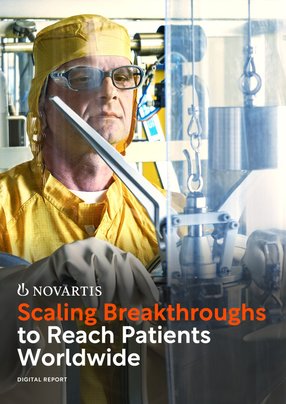
Novartis: Scaling Breakthroughs to Reach Patients Worldwide
For patients, even the most advanced medicine only matters if it arrives when and where it’s needed. That’s why Swiss innovative medicines company Novartis has built its operations network for speed, reliability and reach – making and delivering increasingly complex therapies for people around the world. Leading this effort is Steffen Lang, President, Operations, who has spent three decades helping shape how the company manufactures and supplies medicines globally. With roots stretching back more than 250 years, Novartis has a long track record of pioneering innovation. The company continues to transform breakthroughs into medicines that redefine what’s possible for patients. At its core, this story explores how Novartis, guided by its mission to discover new ways to improve and extend people’s lives, has had to rethink how it plans, produces and delivers treatments at a global scale. For the company, this has often included building reliable supply for therapies that are often complex, personalised and time-sensitive.
Steffen’s path into his role began in research. After university, he joined Novartis as a research scientist before gradually moving into development and manufacturing as he looked for a more direct line to patient impact.
He explains: “In manufacturing, I believe, you’re closest to seeing the impact that our life-changing medicines have on patients.”
It is this patient proximity that has shaped how he thinks about operations. Steffen describes the day-to-day work of his teams as not just running incredibly complex factories and logistics networks, but making sure medicines reach people when and where they are needed most.
Steffen explains: “We have a legacy, at Novartis, of pioneering new innovative treatments and the way we deliver these treatments needs to be as innovative as the treatments themselves.” This has become even more important through the evolution of the Novartis portfolio to one focused on oncology, neuroscience, cardiovascular, renal and metabolic diseases, as well as immunology.
The company’s operational challenge is, therefore, not just scale, but complexity. Some of its newer therapies are highly individualised, others involve radioactive materials and all require precise planning, careful handling and strict quality control.
Operations as a foundation for innovation
Steffen says one of the biggest changes across his career has been the arrival of automation, new technologies and, more recently, artificial intelligence. These tools have changed the way Novartis works, he explains.
“The latest advancements in automation and AI have dramatically changed the way we work for the better,” he says. “Across Operations we are operating in a more connected, more integrated and more end to end way – helping us plan and run at a higher capacity to meet growing demand.”
This shift also matters because Novartis increasingly operates at the frontier of medicine and often is the first to commercial scale new types of treatments. Over the past years, Novartis has focused on three advanced platforms which are revolutionising treatments: cell and gene therapies, siRNA therapies and radioligand therapies (RLT), all of which require manufacturing models that are vastly different from conventional tablets or injections. Cell therapy, for example, involves taking cells from a patient, modifying them in a highly controlled facility, then returning the treatment to the same patient a few days later. Gene therapy has also opened a new route to treatment, while siRNA medicines require complex manufacturing at industrial scale.
RLT, a cutting-edge cancer treatment, is perhaps the most demanding example. It pairs a targeting ligand with a radioisotope to deliver precise radiation targeting cancer cells in the body. And, because the isotope decays quickly, teams are working against time from the moment manufacturing begins.
“We made a bold bet on RLT eight years ago because we saw its potential to become a foundational pillar of cancer care. We started small with a few patients and a few centres,” Steffen reflects. “Now, we supply RLT to patients worldwide, when and where they need it.”
Steffen adds that what makes RLT a particularly unique therapy that it is personalised and individually prepared for each patient. “From the moment you start manufacturing RLT, the clock starts ticking. We need to ensure the correct radioactive dose arrives with the patient at the right time” he adds. “And from start to finish, this all needs to happen in three to five days. We serve patients in remote locations like Hawaii, with treatment made on the US mainland – when you map the steps from production through to administration, you can see how easily time can be lost.”
A growing network of RLT sites across the world, alongside GPS tracking, temperature control and 24/7 monitoring, help support the delivery of these treatments from planning through to patient. Thanks to automation – the tools Novartis uses to predict and to prevent disruptions in logistics and manufacturing – the company can produce the volumes and specialised nature of this treatment at a very-high service level with more than 99% of injections administered on the planned day.
The reliability and strength of the network are constantly put to the test. During the major snowstorm that hit the US in January 2026, for example, air and ground transport were disrupted across the country. The RLT team responded quickly to keep operations moving, maintaining the company’s very high service levels.
“It’s a very different way of working and no easy feat,” Steffen says, “but as pioneers in the space and proven medicines on the market in multiple cancers we continue to deliver with the aim to also go even further, expanding into other cancers in the future. This requires an incredible amount of skill, passion and motivation from our teams who work day-in and day-out to make RLT treatment a reality for patients.”
The importance of building resilient supply
When Steffen reflects on the past 30 years of Novartis, the scale and size of the COVID-19 pandemic, he says, was the biggest global pressure test for supply chains. For Novartis, it reinforced the importance of designing reliability into the system before disruption strikes.
“For us, the worst-case scenario is that there is a patient expecting a medicine and we cannot deliver. That’s why we have focused for many years on optimising our supply chain when it comes to reliability.”
Resilience, for Steffen, begins with a strong global network. Novartis has more than 30 supply points across the Americas, Europe and Asia, and uses dual supply chains for key products to reduce the risk of disruption. The company is also expanding in the US.
“The US is a strategically important location and market for Novartis,” he says. “Last year, we announced a significant expansion to be able to deliver end-to-end development of our innovative medicines, from R&D to manufacturing and supply, for patients in the US.”
Novartis continues to grow its footprint in the US, with seven new or expanded sites announced over the past 15 months – and six of these sites are now already under construction.
“When you reflect on the growth of the company over the past few years, our aim is to make sure that we have enough capacity to serve patients globally.” And, as Steffen emphasises, Novartis has already proven it can in an ever-changing and increasingly volatile environment, all while still delivering very high service levels. But he is clear that resilience is never finished work.
Focus on the fundamentals
For all the discussion of speed, automation and digital scale, Steffen insists the fundamentals remain essential. These fundamentals are product quality, workplace safety, compliance and environmental sustainability.
“The quality of our products, the safety of the workplaces – these are non-negotiable,” he says. “Cost efficiency matters too, Steffen says, but only after the fundamentals are in place. It cannot come at the expense of quality or safety – something that applies equally to conventional medicines and to advanced therapies.”
The importance of sustainability and people
Sustainability is another operational priority. The target is net zero across the value chain – Scope 1, 2 and 3 greenhouse gas emissions – by 2040. Since 2016, Novartis achieved carbon neutrality in its own operations, sourced almost 100% electricity from renewables, reduced waste sent for disposal by 70% and cut water use by more than half – even as its portfolio has grown. The bigger challenge now is Scope 3 emissions.
Steffen says the company is embedding environmental sustainability criteria into supplier contracts covering around 97% of Scope 3 emissions and working with partners to address the main sources of emissions across the Novartis value chain.
For him, though, the real driver is people, whether at Novartis or the many companies it partners with. Steffen describes Novartis as a place where teams understand the patient behind every batch, shipment or production run. He remarks that Novartis teams are more energised than ever in their work to turn scientific breakthroughs into medicines that change lives.
It also explains why Steffen believes the future of operations will be shaped by always innovating, always curious mindset to ensure more patients can access the medicines they need.
“Every day I get up in the morning, I have no question about whether I enjoy what I am doing,” he says. “I come to work because together, we make a huge impact – we redefine the future and give hope to patients.”
Company portals

Executives
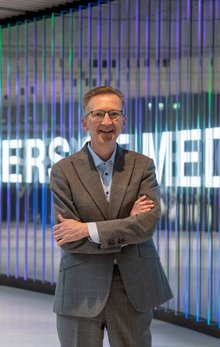
Steffen Lang
President, Operations