
Procurement leaders around the world have been facing new levels of demand, with increasingly heightened expectations. As a result, the role of procurement is changing, unlocked by geopolitical events and the rise in AI adoption.
Traditional procurement was spreadsheet and email heavy, with contracts taking extended periods of time to sign and background checks causing delays – particularly as the geopolitical landscape shifted and the rules of trade moved.
Now, AI has a firm place in the function, taking on the manual, repetitive tasks so that procurement leaders can focus on strategic thinking, supplier relationships and decision-making. As procurement leaders have moved to the forefront of business resilience, digitalisation is becoming a key player.
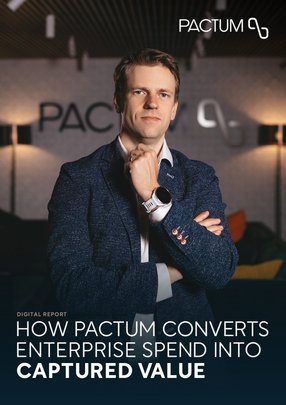
With a background in helping governments with their digitalisation strategies, Kaspar Korjus, Co-Founder and CEO of Pactum, understands that governmental innovation needed AI. Understanding the difficulties this could bring, Kaspar left his governmental position to establish Pactum with his co-founders Christian and Martin.
The principle he carried from government into enterprise was straightforward: systems scale. People do not. Every large enterprise has strong procurement teams, clear strategies and well-defined processes. What they rarely have is enough capacity to act on all of it. The top 50 suppliers get attention. The other 10,000 — representing hundreds of millions in spend — largely do not. The real constraint was never strategic clarity. It was execution capacity.
“Our vision was, from day one, that there will be a future where we are going to work with agents as our colleagues,” he explains.
Finding the procurement problem
Pactum deploys autonomous AI agents across the full procurement lifecycle — handling requisitions, supplier engagement and negotiations at scale, embedded directly into the enterprise systems teams already use. Its agents operate within each client's defined governance framework, executing against business goals and supplier constraints autonomously, without requiring human involvement at every step.
From there, its AI agents can negotiate agreements with suppliers at large scale — not as recommendations for buyers to act on, but as fully autonomous execution, closing commercial outcomes on behalf of the business.
Pactum was established before the LLM era took off, in an attempt to empower businesses throughout their procurement processes.
“We didn't exactly know from day one where they will be applied, but what we knew is that closing deals could become a very value-added activity by agents if they can autonomously close deals, and hence we established Pactum.com,” adds Kaspar.
“Pactum in Latin means agreement, so reaching agreements, and then we built the first chat interface before LLM times, to see how they can work for procurement division, to close deals.”
Pactum first applied these agents across various domains and functions, but following its first meeting with Walmart, its first client, it realised its agents were better suited to procurement. Walmart confessed that 80% of its suppliers were undermanaged, meaning there was a need to have agents interact with suppliers in order to engage and help manage the supply chain more efficiently.
In its early days, Pactum found a real procurement challenge regarding capacity. During its first meeting with Walmart, Kaspar understood that procurement strategy was accurate, but there was an obvious gap when it came to meeting demand.
“We learned that you have a majority of suppliers who we don't find time to work with to negotiate deals, to update contracts to process all the requisitions, update price lists, everything that procurement needs to do, you're focused on more important suppliers, which you should be,” explains Kaspar.
What Pactum built in response goes beyond tail spend. The platform addresses four distinct gaps that every enterprise procurement function faces: the unmanaged suppliers no team has capacity to reach; transaction-level leakage from requisitions and spot buys that bypass scrutiny before a purchase order is issued; post-sourcing value that goes uncaptured once a sourcing event closes; and data quality failures that cause negotiations to start on faulty inputs. Pactum agents address all four — simultaneously, at scale, and natively within the platforms enterprises already run, including Coupa and SAP Ariba.
The product philosophy follows directly from this. An agent that tells a procurement team it could negotiate something is a productivity tool. An agent that actually negotiates it — within defined rules, with full auditability, at scale — is an operating model. Pactum is not a procurement tool, but the execution layer which was missing from the function.
Negotiations reimagined
There is a prevailing assumption in procurement that negotiation belongs in a grey zone — territory that requires human judgment, relationship management and interpersonal skill that no software can replicate. For strategic suppliers and major contracts, that assumption remains valid. But it misses an important point: the vast majority of suppliers are not being negotiated with at all. Not because procurement teams do not care. Because they simply do not have the capacity.
The evidence from Walmart's own supplier base is striking. When Pactum's AI agents began conducting negotiations, 80% of suppliers confirmed they preferred the experience and considered the outcome fair. The concern that suppliers would resist or resent negotiating with an AI simply did not materialise. In practice, suppliers appreciated the responsiveness, the consistency and the absence of the delays that often characterise procurement interactions.
This addresses two concerns procurement professionals consistently raise. The first: will AI agents damage supplier relationships? The evidence suggests the opposite — for the segment of suppliers who previously received no attention at all, structured and timely engagement is unambiguously better. The second: will AI agents replace procurement professionals? The answer is no. Agents handle the volume that humans cannot reach. They do not compete with buyers on strategic accounts; they extend the team's reach into territory that would otherwise go entirely unmanaged.
The safety of the process is built into the architecture. Pactum's agents operate within rigorous guardrails, following defined negotiation parameters aligned to each client's strategy and supplier constraints. The system will not commit outside its authority, will not communicate outside its approved scope, and produces a full audit trail of every interaction.
“Different people build trust differently. We focus mostly on getting the technology right, that it actually adds value autonomously, and building these agentic systems, says Kaspar.
“We are super transparent, what works, what doesn't work, and this is a journey where we try to grow together with our customers, because whatever you have today as technology matters much less than what you have in the next two years, because every year the technology evolves so much.”
As the world evolves in a constant, transformative manner, businesses need to be transparent in order to develop client trust. Amid global pressures and geopolitical tensions, a reliable partner is vital. Pactum demonstrates how this reliability operates alongside changing technologies.
From assistive to agentic
The implementation of AI has a range of benefits in procurement, leading to more efficient and streamlined workflow operations, as well as the ability to move through a much shorter timeline without sacrificing quality.
Kaspar explains: “AI helps to automate many processes, it helps to prepare for meetings and negotiation arguments, but the AI has very clear boundaries and goals and can act independently, within those boundaries to achieve those goals. So it has authority and autonomy to act, and execute decisions on its own, and it can reach out to you as human if needed.”
There are two fundamentally different approaches to AI in procurement — and they lead to very different futures. Assistive AI keeps humans at the centre of every decision. It drafts the email, summarises the RFI and surfaces the recommendation. The human still acts. The workload does not decrease; in many cases it increases, because the system raises expectations without removing the work behind them.
Agentic AI changes the operating model entirely. It acts within guardrails, executes autonomously and delivers outcomes without requiring a human in the loop for every step. The capacity constraint is not optimised — it is removed. This is the distinction that defines Pactum's approach.
“The most complex part of that agentic system is the governance layer,” Kaspar adds.
“How do you manage these agents? How do you set their goals? How do you set their limits? How do you see what they are doing? How do you learn through each interaction so that it can be better next time? How do you fire them? How do you train them?
“If you consider an agent as a young graduate student who comes to your job. You need to describe what the job is about, where do you get data to form decisions, who can you reach out to, what's your goal, how you measure yourself, whether you're successful in your job.
"You need to do that all with humans, but the same is with agents. You can't just put the agent system there and expect that it itself knows what to do."
This is precisely why Pactum's underlying technology is rule-based and deterministic — not a large language model making freeform commercial decisions. Every action is traceable. Every outcome is auditable. The governance layer is not a constraint on the system. It is what makes the system enterprise-grade.
Agentic AI constantly learns, taking information from global networks and major events. As a tool, it adapts to the needs of the company it is applied to, while also remaining vigilant of market trends. As it is constantly learning, it creates a deeper knowledge base for businesses, allowing them to create more informed decisions and confidence in their actions.
Despite their advancements, however, they are not the answer to all problems, as Kaspar acknowledges. Some agents are fully autonomous, whereas others act as an advisory service for humans, across category, strategy or more important business decisions.
The evolution of procurement
As technology advances, the ways in which procurement leaders work with the technology must also change. Leaders must adopt the technology strategically, rather than applying it to processes
“Technology and core models are evolving a lot, but it's no longer a technology problem, it's the change management and adoption challenge and how to change the operating model of large enterprises,” says Kaspar.
“We are learning together with the clients every day, and the agents are becoming more sophisticated. They can do more strategic tasks, rather than just mundane operation work.”
Procurement is changing, becoming more proactive and more resilience focused, rather than just on cost savings. As Pactum begins to utilise agents for decision-making and conversing with clients, it frees up leaders for more challenging tasks.
When exploring how the function is evolving, Kaspar says: “Procurement is finally able to become more strategic, not the cost center, but actually a unit that drives business, because all the operational mundane work can be handed over to the agents who support and assist humans and automate many of those tasks.
“Humans have time to do what they find more valuable; build personal connections with their suppliers, build strategies and category strategies.
The vision is not procurement run by AI. It is procurement run with AI. Agents take over high-volume, repetitive, time-intensive execution — the work that consumes most of a team's day without adding strategic value. Humans retain what requires judgment: supplier strategy, commercial relationships, decisions with reputational consequence. The role of procurement does not shrink. It becomes more valuable.
“All of this can be achieved so that procurement becomes something that thrives in innovation and shows off how it's done compared to other units. Procurement is very well suited for agents, because agents need explainable processes and guidelines, and procurement is all around that.
“I don't see procurement as art, I see it as a science and if you tell all the guidelines, or the principles, the new operating model of procurement can take this over and support humans much more easily than some more creative work.”
Though technological advancements are driving procurement functions, it is important to note that these are helping human workforces take on a more personal role. As the procurement role changes, clients appreciate putting a face to a contract, particularly in today’s volatile climate.
As a result, the addition of AI into a workflow helps procurement teams build personal connections, focusing on a different part of a company strategy than the agents. As Kaspar notes, the implementation of AI allows procurement teams to be more creative within their job role, welcoming a more modern, person-focused approach.
Company portals

Executives

Kaspar Korjus
Co-Founder & CEO