
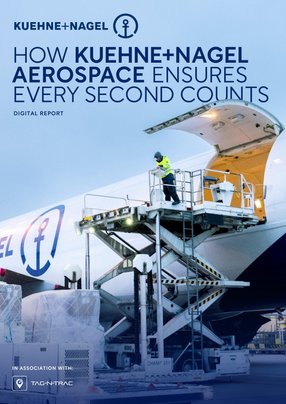
How Kuehne+Nagel Aerospace Ensures Every Second Counts
Precision is everything in the world of global logistics. Within the likes of healthcare and aerospace, there is no tolerance for delays – no matter the circumstances.
When every second counts, information gaps translate into grounded aircraft, disrupted schedules and costs that escalate at speed. Moving aircraft parts, engines and oversized components demands more than capacity; it is equally essential that supplier trust, clarity and quick decision-making works across borders and time zones without hesitation.
Kuehne+Nagel’s Andreas Nyman knows this well. Based in Oslo, he leads the company’s strategic approach to aerospace logistics, shaping how one of the world’s largest freight forwarders supports airlines, OEMs and MROs when failure is simply not an option.
With more than 18 years at the company, his career has seen the evolution of a sector, the increasing centrality of data and the empowerment of the individuals and partnerships within it.
That said, Andreas’ entry into the industry was accidental, led more by curiosity than by strategy. It remains a guiding feature of how he works today.
“I was supposed to become the new Indiana Jones because I wanted to study history,” he says.
“Then this opportunity arose from nowhere and it sounded interesting, to work with the airlines and aircraft. I went in there with a good mindset and, with no intentions, fell in love with it. It's a very unique market because you really learn something every single day, even after (all) this time.”
Empowering decision-making amid chaos
Aircraft have to operate continuously across global networks, meaning problems often also arise on a global scale.
Andreas explains: “The market is never still; there are always some surprises every single year to affect business.”
The volatility the industry experiences is therefore a constant condition, as opposed to the exception. This often means it's easier to simply lean into it.
“My first mentor said it: we should love problems because problems mean opportunities.”
This mindset feeds directly into his approach to management.
“If you give someone responsibility, you get ownership back. So that's what I try to do as much as I can: give responsibility and empower people.”
Andreas was drawn to Kuehne+Nagel by a similar weight of responsibility. Early in his career, he saw how decisions taken at a desk translate directly into movements on the tarmac. Despite it being such a vast operation, the connection between individual action and consequence is immediate.
“You watch how a thing works in reality to and from the aircraft,” he says, “and you realise you have the ability to make a tremendous individual impact.
“It was borderline scary at times, because your decision could have a big impact, but you really got empowered to make decisions.”
Even as his role expanded into strategy and global coordination, this feeling of empowerment and individual responsibility didn’t leave him.
“That's what I still feel today, that you have this empowerment to do a really good job and your actions actually matter and make a difference,” Andreas says.
Specialised trust on a global scale
Kuehne+Nagel operates in close to 100 countries, and employs more than 85,000 people, offering air, sea and road logistics alongside contract logistics and supply chain management. It supports industries ranging from aerospace and aviation to healthcare, semiconductors, cloud infrastructure, renewables and e-commerce.
Yet, size alone does not define its operating model. The organisation structures itself around specialisation, both by transport mode and by industry vertical, allowing teams to respond with speed and expertise.
Beyond transport, Kuehne+Nagel delivers supply chain advisory services, customs management and consultancy, creating an integrated framework that connects planning, execution and improvement. Each division operates with autonomy while drawing on shared systems, data and global reach.
The mission, according to Andreas is “becoming the most trusted supply chain provider in a sustainable manner.” For him, trust is built through transparency, shared capability and long-term alignment.
“We really believe in a partnership,” he says. “For us to grow and for our partners to grow, we need to do it together.”
That means being honest about limitations as well as strengths.
“That's why we're very transparent on capabilities and we build things together. That trust aspect is a very big topic for us.”
Sustainability also enters the conversation early, not as an afterthought.
“When you set something up, how can we also make it not just cost-efficient for a partner, but also how can you minimise the impact of your emissions”
AOG: 30-minute solutions save fleets
Nowhere are these principles tested more harshly than in Aircraft on Ground (AOG). This refers to scenarios where an aircraft is unable to fly due to technical issues, creating immediate operational and financial pressure. Airlines, OEMs and MROs depend on logistics providers to restore movement as quickly and safely as possible.
Kuehne+Nagel provides 24/7/365 AOG support, coordinating urgent collection, customs clearance and delivery of critical parts worldwide. Solutions include expedited air freight, on-board couriers and air charter options, supported by control-tower visibility that tracks every movement.
For Andreas, the core challenge in AOG logistics is not transport itself but information flow.
“I think, overall as an industry, we spend most of our time chasing information,” he says.
“There's a big challenge about communicating information these days: time zones, different ways of working.”
His response focuses on removing friction before it appears.
“So what we have done to minimise the downtime is simply just make data available upfront.”
This leads to a redefinition of service levels.
“Two years ago, we just redefined our product so that we can go to market with a solution within 30 minutes
Meeting that expectation requires systems that operate ahead of human intervention.
“To be able to do that, you need to get the information without human interaction.”
Global AOG teams now access live carrier capacity, station capabilities and local rates through a shared system. Customers receive multiple options immediately, enabling faster operational decisions.
“That prompt communication makes a big difference for most customers to make that decision and plan their actions on the other end.”
How data conquers engine complexity
Applying this logic to engines introduces a different level of complexity.
Engines vary by aircraft type, size and configuration and cannot be standardised in the same way as smaller components.
“We thought, let's just replicate the same process,” Andreas says. “It's a lot more complex to be honest.”
The solution lies in structured data – meaning teams build a comprehensive database mapping engine types to aircraft compatibility and carrier capacity.
“Instead of having every individual user… we just made sure that the system gives it to us upfront.”
While validation calls remain necessary, teams provide informed recommendations within minutes. The same logic extends to other oversized items by breaking data down to dimensional inputs.
“You just type in your dimensions and then the system will allocate the right aircraft type for you,” Andreas explains.
For him, data sits at the centre of everything.
“I would say besides the people, the most important thing is data.”
That said, it does have to be accurate: “If the data quality is not there, we have a problem quite frankly.”
AI builds on this foundation, supporting faster and more consistent decisions while highlighting risks based on historical performance.
“It's combining all that data with the technology that makes it an even better decision for us,” Andreas says.
Data also supports continuous improvement.
“We use the data on the live day-to-day, but then also use that information to improve in the future.”
Future-ready logistics through shared data
Looking ahead, Andreas argues that the industry benefits from deeper data sharing across the aerospace ecosystem.
“Quite frankly, I think we as an industry need to go together from end to end.”
He links this to predictive maintenance, where airlines anticipate failures and plan logistics accordingly.
“Imagine if you know that in the system without even asking; that will mitigate a lot of the risk on the supply chain.”
He actively invites collaboration: “I'm volunteering to join any airline or OEM to start doing something together.”
This means that for Kuehne+Nagel partnerships are non-negotiable.
“I would say we are only as good as our partners, simple as that. They need to challenge us to become better and vice versa.”
The company launched maximum visibility labels powered by Tag-n-Trac – which provides a unified, IoT-enabled hardware and software platform for logistics automation. The labels can measure parameters, such as temperature and humidity and exposure to shock, tilt, vibration and light which are key to protecting sensitive cargo along its journey.
“We learn a lot from them and they also learn from us.”
Automation, in his view, isn’t about removing human judgement; it’s about eliminating repetitive tasks and inefficiencies that slow decision-making. “What we are aiming to do is stop the collecting part,” he says – referring to the laborious process of gathering information that systems can easily automate.
The goal is speed without compromise: “We can transform information gathering from minutes to seconds.”
By doing so, teams are freed to focus on what truly matters – interpreting data, making decisions and taking swift, informed action.
Despite not quite reaching the heights of Indiana Jones, Andreas had developed a career which reflects the same heroic intentions – empowering people with the right data to ensure that when a problem surfaces, the solution is already in motion.
Company portals

Executives
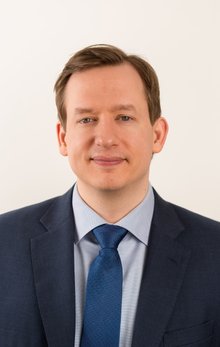
Andreas Nyman
VP Global Head of Aerospace, Air Logistics